In uncertainty, be vulnerable
Uncertainty is often seen as something to protect against. But protection is not always a good idea.

I recently spoke with a disillusioned executive from a large industrial company. Concerned about the growing uncertainty, his boss centralized decision-making and now requires detailed validation of all decisions, even operational ones. Middle managers are frustrated and demotivated, and company operations have become much more cumbersome. Despite numerous protests, however, the manager will not budge.
Such a situation is not surprising. After all, a predominant management mindset, one that I have heard expressed many times, is that leaders should reduce uncertainty for their team. Management research has also long shown that the dominant reaction to uncertainty, and to sudden external shocks in particular, is protection based on reinforcement of existing practices rather than questioning them. The predictive posture is reinforced by trying to predict “better,” developing analyses and scenarios, and calling on more experts to decipher an opaque future. Organizationally, centralization is accentuated to accelerate and better control decisions, based on the belief that greater control allows for better mastery of events. Yet, once the storm has passed, it is difficult to change course. While this reaction to rigidify systems and postures seems logical and is not entirely without merit, it is counterproductive in the face of uncertainty.
Uncertainty is a matter of posture.
Uncertainty can be defined as the absence of objective information about a phenomenon. This uncertainty stems from the fact that the phenomenon is largely unprecedented, complex, and develops over a long period of time with numerous dimensions. The Covid pandemic is a good example. Unlike a roll of the dice or a car theft, its origin is difficult to determine. We don’t know when it will end—if it ever will. Its consequences are numerous and often unpredictable, including sanitary, social, economic, and political consequences. These consequences will probably continue to develop for years to come. The war in Ukraine is another example of a phenomenon characterized by great uncertainty.
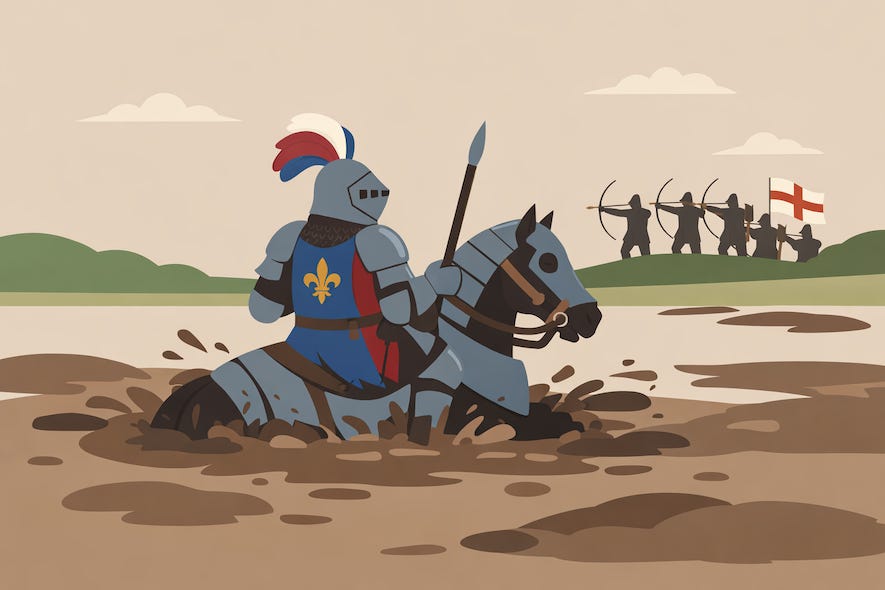
The problem with an overly assertive posture of protection and control is that, by trying too hard to protect ourselves, we end up isolated from reality. No matter how strong an armor may be, it is never a universal solution, as the French chivalry’s defeat at the Battle of Agincourt clearly showed. One can have strong armor and still get stuck in the mud. In fact, the heavier the armor, the more likely one is to get stuck and become an easy target for archers. Protection has a cost.
Therefore, the paradox of a protective posture in uncertainty is that it increases the risk of failure. However, the danger of this posture extends further. By reducing our capacity for action in the name of reducing risk, we also miss out on the opportunities created by uncertainty. If uncertainty is a source of danger, it is also a source of opportunity. Uncertainty exists because the future is not determined. If it were determined, we could do nothing; we would merely be spectators of independent “historical forces.” Uncertainty is thus the condition of human action, particularly creative action. It is inherent in the actions of individuals who create novelty in the world, such as artists, scientists, entrepreneurs, and innovators. These creators demonstrate that, while they cannot always control what happens and are not necessarily able to predict it, they can control how they take advantage of it. They relinquish control over reality, which is largely illusory anyway, to focus on what they can control: their actions in relation to reality.
They shift from a protective posture to an open one.
The key to acting in an uncertain and unexpectedly changing reality is maintaining a creative connection to it. This does not mean abandoning the idea of protection entirely, but rather not reducing one’s posture to protection alone.
The only way to create or recreate a creative connection with a changing reality is to open up and let air and light in. This means accepting vulnerability, which characterizes “that which can be easily reached.” We must accept that we can easily be affected by reality and its surprises, along with the risks this entails.
Vulnerability allows for a better connection to reality because it permits things to pass that we would normally want to block. This means leaders must admit humility in the face of reality and accept that vulnerability is a strength.
When faced with uncertainty and change, adapt the management mindset.
Of course, vulnerability is not an easy concept to sell to managers. They have been trained and indoctrinated with the idea that leaders know, plan, and can do everything. They must also protect their teams, who are supposedly less capable of thinking and acting for themselves and are afraid of an uncertain future. This mental model is a medieval legacy and must evolve.